Synthwave, 80’s Nostalgia, and Longing for a Time That Never Was
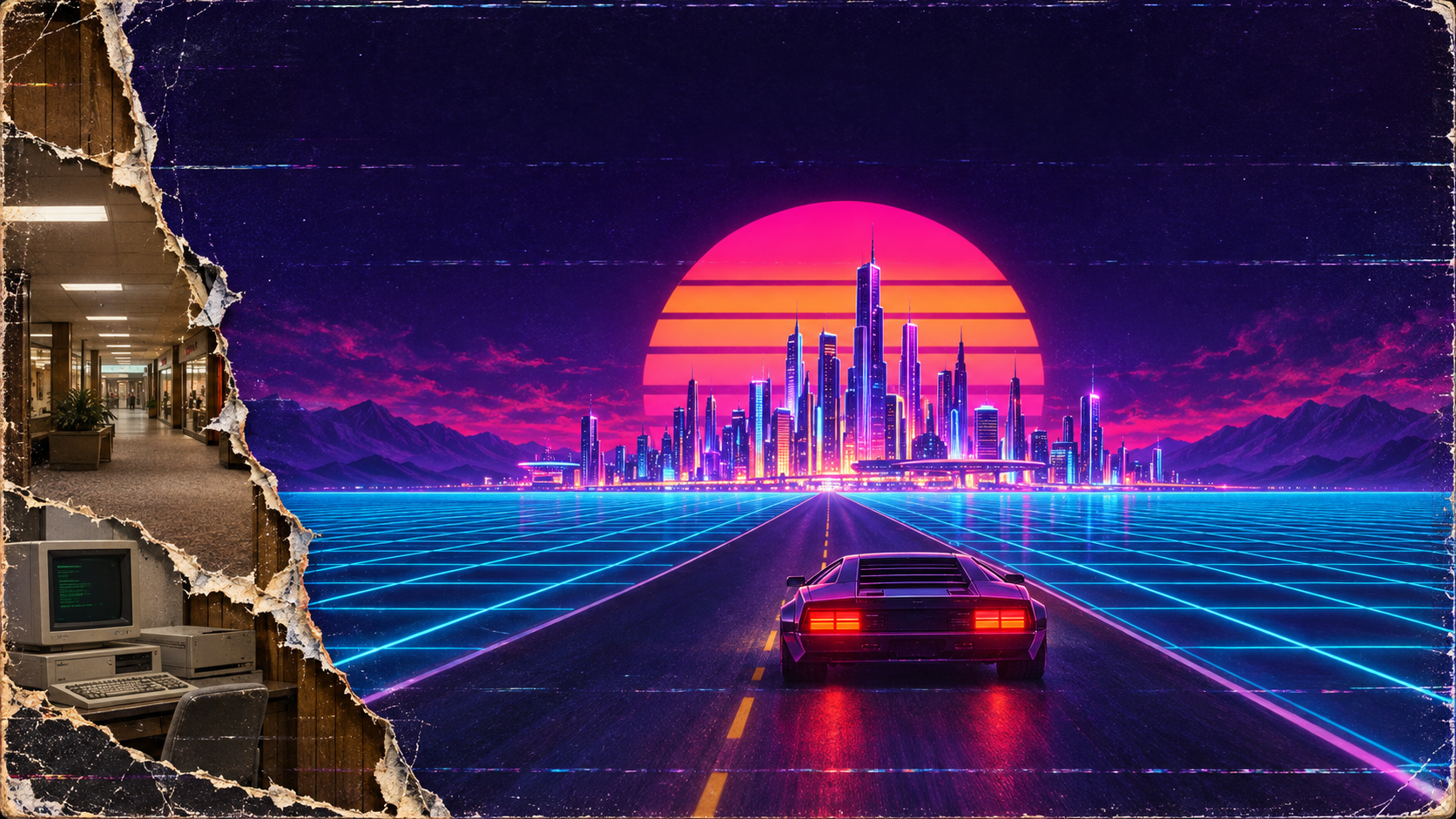
A sports car races toward a glowing city in the distance as the sun dips below an infinite neon plane. The journey is scored by analog synthesizers, punchy drum machines and cinematic melodies. Welcome (back) to the world of synthwave, a music genre and aesthetic that reconstructs the sounds and images of 80s music, movies, video games, and technology. But rather than simply reconstructing the decade itself, synthwave brings us back to the future that 80s pop culture taught people to anticipate when technology was still promising and alluring. It is effectively synthesizing 80s pop culture and media references into a reimagined, futuristic version of the decade.
More than that, synthwave also evokes a strange emotion in listeners: anemoia, a feeling of nostalgia for a time or place you have never personally known or experienced. The neon landscapes feel familiar, as though we’ve driven down these highways before. Yet most synthwave listeners were not even alive during the 80s and this world they’re “remembering” never existed at all. So how can music make us feel like we remember a place which we’ve never actually visited?
The analog-style synthesizer, a staple of 80s film scores, arcade games, television themes, and pop music, is the heart of synthwave. Listeners without memories of the decade have still learned to associate these sounds with the 80s through later media. Further, the synthwave aesthetic and sound is built around motion, as if we are going somewhere while repeating arpeggios and basslines propel us forward. The heavy reverb gives the impression of large open landscapes as notes echo across empty spaces. The drums are gated: a technique of applying large amounts of reverb, but then cutting off that reverb with an unusual abruptness. The result is that they sound huge but punchy, like an engine cycling. Bright melodies often sit over darker, minor chords, producing a bittersweet sound as the harmony oscillates between feelings of hope and loss. And because synthwave is mostly instrumental and repetitive, it leaves space for the listener to complete the scene.
Research into reconstructed nostalgia has found that listeners of genres such as synthwave, vaporwave, and chillwave collectively imagine scenes and personal histories around fictional times and places, and knowingly participate in a fictional past because the synthwave aesthetic makes that participation enticing. It is an alluring world of freedom and adventure: fast cars, open highways, palm trees, summer nights, and infinite possibility.
Combine this with the reinterpretation of the 80s as a time of stability (as we often do with the past), and you have the perfect ingredients for an idealism which invites listeners to engage with it as a form of play. One draws upon their own lived experiences (childhood, teenage summers, feelings of comfort, etc.) in order to plug into these liminal spaces and suspend disbelief. The synthwave aesthetic is therefore built on a common but reconstructed past that gives listeners the agency to appropriate this past in a personal way. Personal memories begin to blur with a collective memory of the decade until it becomes difficult to tell where one ends and the other begins, and the result is anemoia.
But what makes this 80s retro-futurism realm so enticing as a form of escapism? Is the answer found, at least in part, by looking at what one might be escaping from?
Consider the technology from the 80s. Cars, retro TVs with buttons and knobs, cassette players, bicycles, radios, glowing arcades. These are machines with clicky controls that require a physical input and deliver an actual experience in return. A cassette had to be manually turned over, and an arcade was a real place that you had to go to. These devices had visible purposes and clear boundaries. The old television could be turned off. The old telephone could not follow you outside. The pinball table waited for you to approach it. You used them and then left them behind.
In contrast, modern technology increasingly oversteps these boundaries. The phone can’t be left behind because it wakes us up, maps our route, manages our work, delivers our entertainment, records our memories, mediates our relationships, and follows us back into bed. It is not simply another object within the world. More and more, it is the object through which the world is experienced.
Maybe this is why the clicky buttons matter so much. They represent a world in which human intention still appears directly connected to material consequence. You press a button and then something happens. Cause and effect.
But now reality reaches us through screens, images, feeds, clips, notifications, which are all being orchestrated by the omnipresent, omniscient, and omnipotent algorithm. These systems remain invisible while they deny job applications, replace workers, or decide what memes you see next.
80s pop culture recognized that autonomous technology was a real threat, but those threats still had bodies; they were human-like robots, corporate towers, computer terminals, etc. They could be located somewhere in space. In other words, dystopia had a physical form.
So the dangers of the 80s still seemed tangible enough to understand and confront, whereas the threats of the modern world are invisible, all-knowing, and all-powerful. And certainly not benevolent.
Modern technology has not only slipped the grasp of human control, it has also changed the texture of human experience itself. Screens intensify what Jean Baudrillard called hyperreality: the point at which signs no longer merely represent the world but begin to stand in for it, causing the distinction between lived experience and simulation to collapse. The screen has become the surface through which reality itself is delivered. Fredric Jameson connected this condition to contemporary culture’s inability “to focus our own present,” or to create aesthetic forms capable of representing what modern life actually feels like.
Maybe that is why the past keeps returning. The present moves too quickly, and through too many layers of mediation, to become a shared memory.
So we borrow the already familiar images of another decade because our own has failed to produce an image of itself. This may explain why the world of Stranger Things feels so complete by comparison. Hawkins is a Rockwellian fantasy of the American small town. Kids ride their bikes across town. Teenagers drive fast muscle cars. Friends gather in basements, argue over radios, and find one another without “dropping a pin.” It is a world small enough to know and become physically part of. Hawkins was obviously never the real 80s, but its unreality is part of its appeal: it offers an alternative reality that we can enter and feel inseparable from. Deep down, isn’t this what we really want? A world we can feel connected to? One with? Per Kate Bush, you wanna feel how it feels, yeah?
That may be the deepest appeal of Hawkins and of nostalgia itself. These tropes offer a world that still has room for us, one in which we can belong. Time was abundant, adventure occurred everyday, and someone else was responsible for holding the world together. Water was for gardens, not data centers, and drugs were something you smoked with your friends, not scrolled on, alone and addicted, all day and night.
It’s why Matthew McConnaughey’s character from Dazed and Confused is so damn legendary. Wasn’t there something magnetic about the world when you knew it contained guys like that? When car seats were leather, and you had no choice but to actually talk to a girl in real life?
Maybe I’m falling into the same trap. Maybe everyone in the 80s and 70s thought the same thing about the 60s. Maybe every generation looks backward for beauty. Perhaps longing for an idealized version of the past is a universal tendency, but even so, the objects we choose to long for are not arbitrary. Cars with glowing dashboards and cassette players, endless highways, awaiting cities, music that allows you to drift outside of time and space; these things tell us something about what we feel that our own world has lost.
So while nostalgia is certainly a form of revisionist history that helps turn our memories into a coherent narrative, synthwave is performing a stranger version of that process. It gives us an alternative future, grounded in 80s nostalgia, to help us cope with the future that we got. The listener escapes into a neon world of bittersweet synth melodies and endless possibilities, sips from a liminal drug and thinks “things could have been better, and they were,” even if they weren’t.
In its purest form, this is hope; hope that what still lies ahead is a world that is worth remembering. A world that does not merely surround us but requires our participation. Perhaps synthwave’s escapism isn’t anything groundbreaking or original, it’s simply the glimmer of hope that tomorrow might have us reintegrated into a world that we feel part of, and that the future might someday feel human again.
